
Kitchen steel screens
A kitchen steel screen is a glazed steel partition that separates a kitchen from a dining area or snug, either sitting on a low dwarf wall or running floor to ceiling. It keeps cooking noise and smells in the kitchen while the light from a rear extension still reaches the rest of the house.
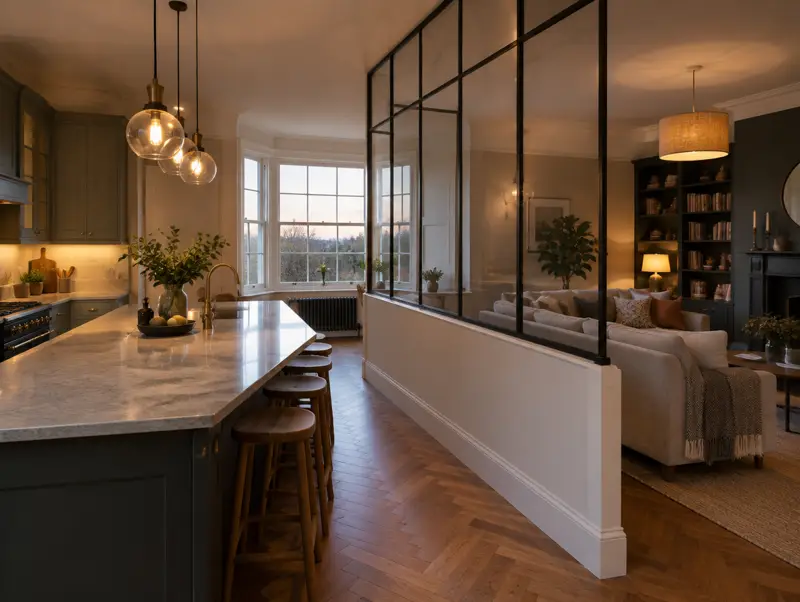
How kitchen steel screens work
Kitchen screens are popular in Victorian and Edwardian houses where a side-return or rear extension has made the kitchen bright but left the middle room dark. A screen on a dwarf wall gives you a worktop or seating edge on one side and keeps the room feeling connected.
Because a kitchen sees heat, steam and grease, we use a hard-wearing powder coat and recommend a laminated pane near hobs. We coordinate with your kitchen fitter so the dwarf wall, worktops and screen line up on the drawings before anything is made.
What you can specify
- On a dwarf wall, a half-height upstand or full height
- Coordinated with kitchen fitter drawings and worktop heights
- Durable powder coat suited to kitchen heat and cleaning
- Toughened or laminated safety glass, clear or reeded
- Optional door or open walkway into the dining space
- Black, bronze, deep green or any RAL colour
- Slim glazing bars that keep sightlines across the room
What happens after you get in touch
Tell us about the opening
Send the form, call or chat, or use the guide-price tool for a quick estimate.
Free survey
We measure the opening, check fixings and regulations, and talk through layouts, glass and finish.
Drawings and fixed quote
You get a drawing and a fixed written price naming the material, glass and finish.
Made and fitted
Your screen is fabricated, powder coated and fitted by our team, usually 4 to 6 weeks from sign-off.
Questions about kitchen steel screens
How much does a kitchen steel screen cost?
A steel screen on a dwarf wall usually costs £2,800 to £6,500 fitted, including VAT. Full-height screens and screens with doors sit at the upper end.
Will a screen stop cooking smells spreading?
A screen with a closing door contains most smells and noise. An open-ended screen still helps, but good extraction over the hob does most of the work.
Who builds the dwarf wall?
Your builder or kitchen fitter usually builds the dwarf wall. We give them the finished height and fixing details so the screen sits level and tight.
Is glass safe next to a hob?
We specify safety glass throughout and advise keeping a sensible clearance from the hob. Where a pane is close to cooking, laminated glass is the safer choice.
Can you match my kitchen colour?
Yes. Steel screens are powder coated, so we can match most RAL colours, including the deep greens and bronzes often used on kitchen cabinets.
When should the screen be measured?
After the dwarf wall is built and plastered, and ideally after the worktops are templated, so the screen is made to the finished sizes.
Kitchen steel screens near you
We survey and fit kitchen steel screens across England, Wales and Scotland. Choose your county for local details.
- London
- Surrey
- Kent
- East Sussex
- West Sussex
- Hampshire
- Berkshire
- Buckinghamshire
- Oxfordshire
- Hertfordshire
- Essex
- Bedfordshire
- Cambridgeshire
- Norfolk
- Suffolk
- Lincolnshire
- Bristol
- Somerset
- Gloucestershire
- Wiltshire
- Dorset
- Devon
- Cornwall
- West Midlands
- Warwickshire
- Worcestershire
- Staffordshire
- Shropshire
- Herefordshire
- Leicestershire
- Nottinghamshire
- Derbyshire
- Northamptonshire
- Greater Manchester
- Cheshire
- Merseyside
- Lancashire
- West Yorkshire
- North Yorkshire
- South Yorkshire
- East Riding of Yorkshire
- Tyne and Wear
- County Durham
- Northumberland
- Cumbria
- Cardiff and the Vale
- Swansea and Neath
- Newport and Monmouthshire
- North Wales
- Mid and West Wales
- Edinburgh and the Lothians
- Glasgow and Clyde
- Aberdeen and Aberdeenshire
- Fife
- Dundee and Angus
- Stirling and Perth
- Highlands
Related products
Book a free survey
Tell us about your opening and we will arrange a survey and a fixed written quote.